
Recherche
Les recherches les plus fréquentes :
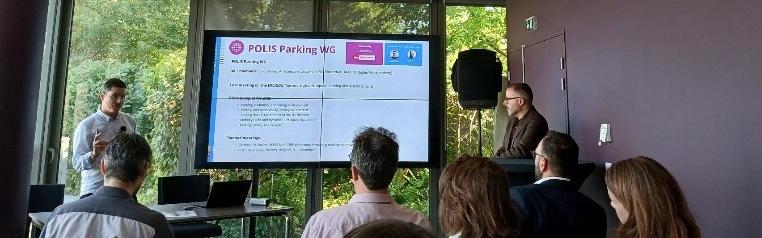

On 29 and 30 September 2026, Lille Metropole hosted a joint in-person meeting of the POLIS Parking (chaired since several years by Lille Métropole-Olivier Asselin) and Clean Vehicles & Air Quality (CV&AQ) Working Groups.
Bringing together European cities, mobility experts and key stakeholders, the two-day event explored how parking policies, electric vehicle (EV) charging infrastructure and energy management can be better integrated to support the transition towards more sustainable and inclusive urban mobility.
The meeting took place at Lille Metropole’s headquarters, Biotope, on the first day, and at the House of Sustainable Mobilities in Lille on the second.
Day 1: Integrating parking, EV charging and energy management
The meeting opened with a welcome address by Frédéric Cauderlier, Mayor of La Bassée and Lille Metropole’s political representative within POLIS, who welcomed participants and highlighted the importance of European cooperation in addressing the challenges of sustainable urban mobility.
The first session examined how European requirements on building energy performance and alternative fuels infrastructure can be translated into the planning and construction of parking facilities. Participants discussed the need to anticipate future EV charging demand while addressing operational challenges, including fire safety risks associated with electric vehicles.
A second session explored the close links between parking, charging infrastructure and energy management. Discussions highlighted the importance of coordinating local parking and e-mobility policies, improving energy management and making better use of renewable energy sources.
Participants also took part in a site visit to Lille city center and an Indigo car park, providing an opportunity to connect the discussions with local infrastructure and practices.
Day 2: Improving accessibility and data management
On the second day, discussions focused on accessibility, with contributions from the European Disability Forum and POLIS.
Participants exchanged views on how to make parking spaces and EV charging infrastructure more accessible, from the design and dimensions of parking spaces to charging equipment and payment methods. The discussions also highlighted the importance of coordinating accessible parking and charging facilities, particularly where public space is limited.
The final session addressed data requirements under European frameworks, including the Multimodal Travel Information Services (MMTIS) regulations and the Alternative Fuels Infrastructure Regulation (AFIR).
Speakers from NAPCORE and the French Ministry of Transport discussed the role of public authorities in providing and managing mobility data, as well as the importance of cooperation between local authorities and National Access Points.
By bringing together expertise on parking, clean vehicles, accessibility and data, the joint meeting highlighted the importance of a coordinated approach to urban mobility.
Lille Metropole was pleased to welcome the POLIS community and contribute to these discussions, reinforcing the value of European cooperation in developing more sustainable, accessible and future-ready urban mobility systems.


