
Recherche
Les recherches les plus fréquentes :
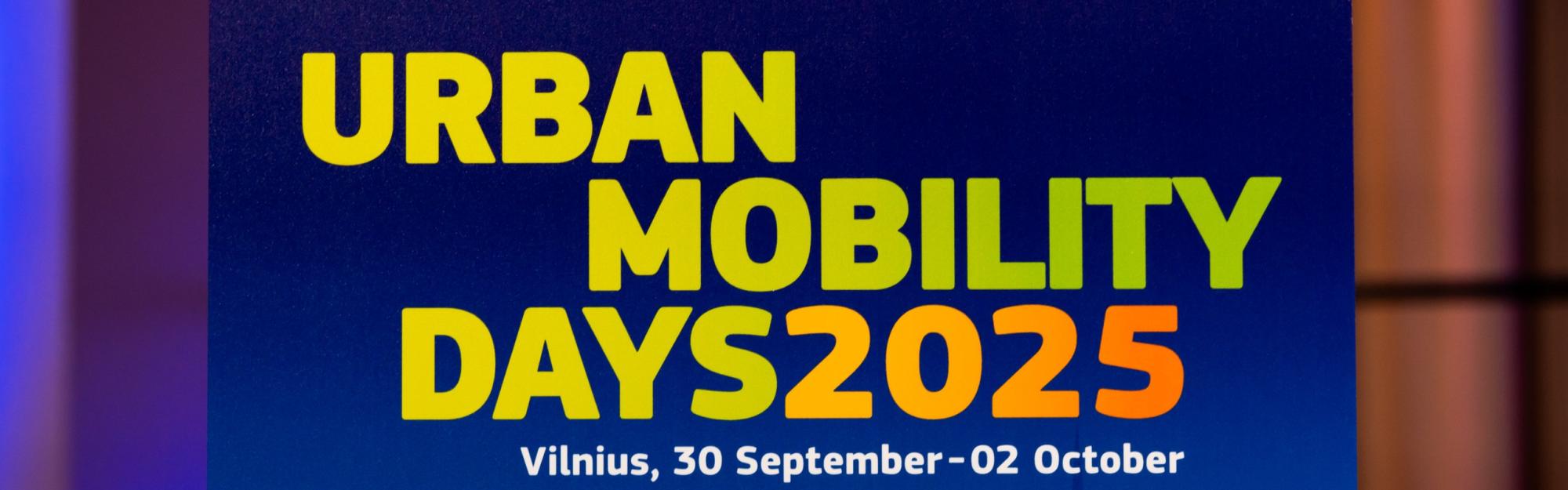
From September 30 to October 2nd, Lille Metropole (MEL) took part in the European Commission’s flagship urban mobility conference, Urban Mobility Days 2025, held in Vilnius, the 2025 European Green Capital. The event placed urban mobility within the EU’s new priorities on sustainable prosperity, competitiveness and social resilience.
Across three days dedicated to urban nodes, cycling and public transport, Lille Metropole highlighted its vision for improving connectivity between dense urban centres and surrounding territories, including cross-border areas.
Connecting Urban Centres and Outskirts: Lille Metropole at the Heart of the Debate
Lille Metropole contributed to a high-level panel on “Better connectivity between urban areas and the outskirts”, addressing mobility needs in suburban and peri-urban environments.
Edouard Fleury, Senior Policy Officer for Territorial Cooperation, represented the Metropole alongside POLIS, EMTA, the French National Agency for Territorial Cohesion (ANCT) and Bolt. Discussions focused on improving accessibility, integrating networks and strengthening mobility planning across functional urban areas.
Cross-Border and Metropolitan Mobility Challenges: Lille Metropole’s Contribution
Lille Metropole presented mobility challenges linked to infrastructure and network development, including the SERM (Service Express Régional Metropolitain - Metropolitan Regional Express Service) and the broader cross-border ecosystem.
It also underlined freight and logistics issues related to major European corridors such as the Seine-Scheldt connection within the North Sea-Mediterranean TEN-T corridor.
These elements showed how metropolitan mobility strategy must align local priorities with European transport dynamics, supporting economic development and labour market accessibility.

A New Public Service Concession: Structuring Mobility
Lille Metropole also introduced its updated governance model for public transport.
In February 2023, the Metropolitan Council approved a new Public Service Concession (PSC) for the Ilévia network, metro, tram, bus and on-demand transport, from April 2025 to December 2031.
The concession also covers the V’Lille bike-sharing service, Handipole accessibility services and park-and-ride management. KEOLIS was selected as the future concessionaire in October 2024.
The new model aims to reinforce multimodal integration, particularly through stronger links with the regional TER (Trains Express Régionaux – Regional Express Trains) network.
Scaling Up Mobility for the Outskirts: New Express Lines and FLEXITY
Looking ahead to 2026 and beyond, Lille Metropole presented several improvements designed to strengthen connectivity between the metropolitan core and outlying areas.
A new generation of Express bus lines will offer faster links to major hubs such as Lille-Flandres station, Armentières, Comines, Halluin, Leers and Villeneuve-d’Ascq. In 2029, the E4 line will be split into two branches to improve reliability and speed.
Lille Metropole also introduced FLEXITY, its future reservation-based transport system. Beginning in September 2026, all on-demand services will be unified under the Flexity name and expanded to 30 lines. By 2031, the system is expected to provide 72% more transport options and generate 165% more ridership compared to 2023.
By participating in this major EU mobility event, Lille Metropole was able to present its ongoing work and share perspectives on cross-border accessibility, suburban connectivity and multimodal integration, topics that are increasingly central to the EU’s transport agenda and to future policy and investment frameworks.


